One Tap Has Saved Water Across India For 90 Years. An Insurance Officer Built It
If you’ve travelled by train in India, you have almost certainly used this invention. You are on an Indian Railways train, somewhere between stations, and you step into the washroom to wash your hands. The tap does not turn or twist. You simply push it with a short, firm press an

If you’ve travelled by train in India, you have almost certainly used this invention.
You are on an Indian Railways train, somewhere between stations, and you step into the washroom to wash your hands. The tap does not turn or twist. You simply push it with a short, firm press and water flows.
But the moment you let go, it stops. No dripping, no running and no water pooling on the floor because someone walked away without closing it.
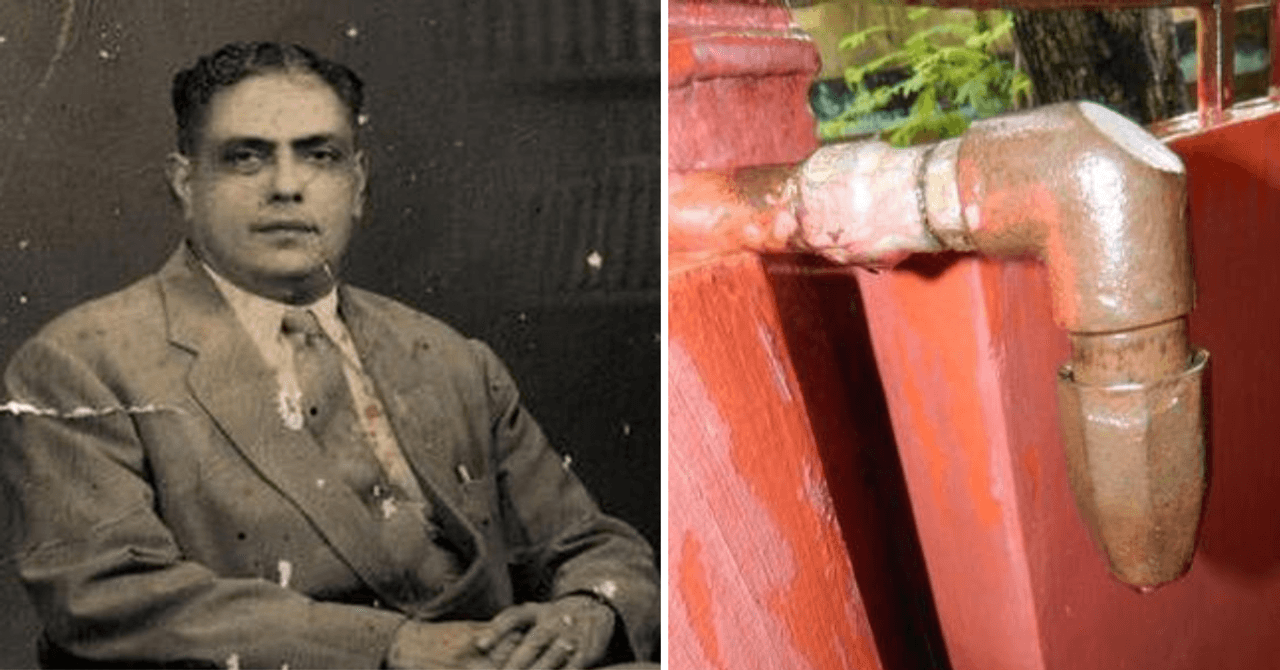
Most people press it, wash their hands, and think nothing of it. But that small, spring-loaded tap has a name, a birthplace, and an inventor. It is called the Jaison Water Tap, it was born in Travancore in the early twentieth century, and the man who made it was not an engineer, but an insurance officer who got tired of watching water go to waste.
The problem no one thought to fix
India has nearly 17% of the world’s population but only 4% of its freshwater. By 2050, half of the country’s districts could face severe water shortages. Globally, we lose 324 billion cubic metres of freshwater every year, enough to meet the needs of 280 million people, according to the World Bank.
A century ago, JP Subramonya Iyer saw the most obvious form of this problem on Travancore’s roadsides: public taps left open, water running freely into the ground while no one benefited.
That carelessness hasn’t gone away. Today, about one in three people in India leaves a tap running, wasting around five litres a minute. This adds up to roughly 49 billion litres of water lost every day.
Iyer’s solution was the Jaison Water Tap, also called the ‘Waste Not Water Tap’. It is a self-closing, water-saving tap invented in the early 20th century in Travancore, now part of Kerala.
Iyer was an insurance officer, not a plumber. His job had nothing to do with taps, but everything to do with spotting risks and inefficiencies that others ignored.
How the tap actually works
The Jaison tap is clever because it is so simple. Inside, a spring keeps the tap closed by default. When you press the knob or lever, the spring compresses and lets water flow. As soon as you let go, the spring pushes the tap back to its closed position. Water only comes out when someone is actively holding it — it can’t run by itself.
The Jaison tap is a great example of homegrown innovation turned into something that could reach everyone. Photograph: (Asianetnews)
This design removes the need for human memory or discipline entirely. A person at a public tap on a hot summer afternoon — distracted, in a hurry, or simply careless — cannot accidentally leave the Jaison tap running.
The mechanism makes negligence structurally impossible, which is precisely what makes it so well-suited to railway stations, communal water points, and any public space where no one is responsible for the tap once they walk away. It is conservation built into the object itself.
The patent that made history
With the help of engineer friends Sri Rajangam, the deputy chief mechanical engineer of the South Indian Railway Company, and S L Narayanan, Subramonya Iyer developed the tap, patented the invention, improved it further, and patented the improved version as well.
The Jaison water tap was the first of its kind to be patented. The Jaison tap is a great example of homegrown innovation turned into something that could reach everyone.
Iyer knew that an idea only makes a real difference if it can be made reliably at scale. So he set up a small factory in Karamana to produce the taps. Later, because of labour unrest in the area, the factory moved to Coimbatore, but the focus remained the same: getting the invention into the hands of people who needed it.
From Travancore to the world
The tap spread to Nepal, Sri Lanka, and Bhutan, particularly in rural environments. HydroPlan, a German company, then purchased the rights to produce and distribute it worldwide after which it spread to Europe, England, and Japan.
An invention born in a princely state in peninsular India, designed to stop water waste at roadside taps, was commercially acquired by a German firm and introduced to some of the most industrialised nations on earth.
The Jaison tap had solved a universal problem, one that was not uniquely Indian but simply most urgent in places where every wasted litre carried real consequences.
Back home, Indian Railways continued to use it widely across the country, inside trains and at stations, in both metal and plastic variants. The tap that Subramonya Iyer built for Travancore's roadsides ended up on every major rail route in the country, serving hundreds of millions of passengers who pressed it, used it, and never thought to ask where it came from.
What the tap tells us this summer
Ironically, its use in Kerala has steeply declined in the 21st century, as public taps on roads face extinction due to the increased use of bottled water by the state's relatively affluent population.
The tap designed to prevent waste at public sources has been quietly retired in its own home. Meanwhile, renewable water availability per person has fallen by 7% over the past decade globally, according to the FAO's 2025 data, with pressure on freshwater resources increasing across several regions.
The Jaison tap had solved a universal problem, one that was not uniquely Indian but simply most urgent in places where every wasted litre carried real consequences. Photograph: (The Indian Express)
In that context, the Jaison tap — a device that conserves water without asking anything of its user, because it simply closes itself — looks less like an artefact of the past and more like a principle worth returning to.
The next time you press that tap on a train and feel it snap back into place, you are experiencing the full weight of that idea which is still working, still saving water, more than a century on.
Sources:
'Jaison Water Tap': Wikipedia, The Free Encyclopedia, last edited 2024
'Innovators and patent holders': by Achuthsankar S. Nair for The Hindu, Thiruvananthapuram edition, Published on 13 January 2017
'World Annual Fresh Water Losses Could Supply 280 Million People': by World Bank, Published on 4 November 2025
'Renewable water availability per person plunges 7 percent in a decade as global scarcity deepens, FAO data shows': by the Food and Agriculture Organization of the United Nations, Published on 12 December 2025
This good news was originally reported by The Better India.
Read the full story at the source →More good news

They Were Told Girls Don’t Play Hockey. Today, They Stand as Asia Cup Champions
The Better India · Jun 9, 2026