How Utah Is Looking Out for Kids Who Lose a Parent
“My kids lost their dad in 2020,” says Ashlyn Stone. Her partner, Hayden Hansen, died on the way to the hospital after a car accident in Kaysville, Utah. Though she has two children, Stone says that no one, including those working for public agencies, reached out to offer support

“My kids lost their dad in 2020,” says Ashlyn Stone. Her partner, Hayden Hansen, died on the way to the hospital after a car accident in Kaysville, Utah.
Though she has two children, Stone says that no one, including those working for public agencies, reached out to offer support for her family. “We didn’t actually receive a lot of resources,” she says.
Stone was also initially misinformed: She was told that her children were not eligible to receive Social Security survivor benefits because Stone and Hansen had been unmarried at the time of his death.
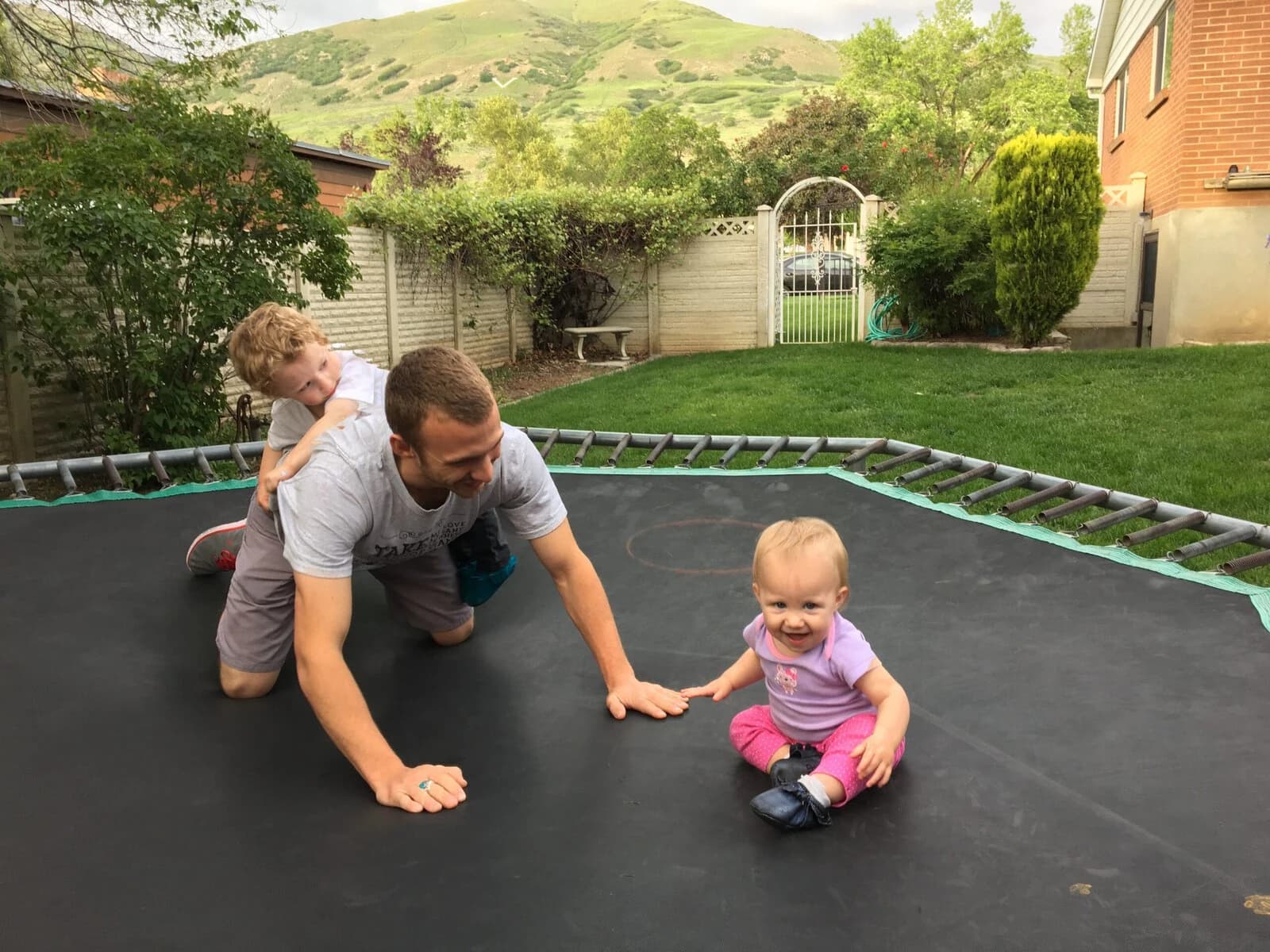
Hayden Hansen, father of Eli and Ivy, passed away in 2020. Courtesy of Ashlyn Stone
Stone eventually turned to family and friends. Her aunt, a financial planner, helped her access Social Security survivor benefits. A friend who’d lost her own parent as a child recommended therapy for her children. Stone also discovered The Sharing Place — which offers grief support for children and adults — when she moved near one of the nonprofit’s locations.
Like Stone and her kids, bereaved children and their families across the United States often lack the support they need. Fewer than half receive the Social Security survivor benefits — averaging $1,100 per month — that they are eligible for. Many also don’t have access to grief care and counseling after the loss of a parent or caregiver. Children in Black, Tribal and rural communities are particularly underserved. Many live in areas researchers have called “bereavement deserts.”
Weighed down by negative news?
Our smart, bright, weekly newsletter is the uplift you’ve been looking for. [contact-form-7]
But in Utah, that’s beginning to change: Since 2023, state officials and nonprofits have been helping bereaved children there access Social Security survivor benefits and other resources.
On the rise and often overlooked
What Stone’s children experienced was tragic but unfortunately not rare: Two-thirds of all children will experience a traumatic event before age 16. The death of a parent, one of the most common, is also one of the most distressing.
Nationwide, an estimated 5.5 million children (7.6 percent) in the U.S. will experience the loss of a parent, according to Judi’s House/JAG Institute, a nonprofit center supporting grieving children and families based in Aurora, Colorado.
Nationwide, nearly eight percent of children will lose a parent. Courtesy of Ashlyn Stone
A study published in Nature Medicine in 2025 found a dramatic rise in the numbers of children whose parent or primary caregiver died in recent years. From 2000 to 2021, new instances rose by nearly 50 percent, while the total number of impacted children grew by about 8 percent.
“The majority of kids who lose a parent will go on to lead healthy, happy, productive lives,” says Julie Kaplow, an expert on childhood grief and director of the Trauma and Grief Center at Meadows Mental Health Policy Institute in Texas. “What we don’t want to do is pathologize all grieving kids.” However, a child whose parent dies is more likely to face mental health challenges such as depression, anxiety and post-traumatic stress disorder (PTSD), with symptoms often lingering for years. One study published in 2018 found that such losses had a significant impact on children’s academic and social functioning in the years that followed, showing the importance of early evidence-based interventions, especially within the first two years.
Kaplow says that roughly 20 percent of children will develop prolonged grief or maladaptive grief, usually linked to risk factors such as limited social support, preexisting mental illness, or multiple traumas or losses. With these children, “it is critically important that we identify them early on” and intervene as soon as possible.
Multidimensional Grief Therapy training with the clinicians at Primary Children’s Hospital in Salt Lake City, Utah. Courtesy of Julie Kaplow
Treatments for trauma and grief are not the same, Kaplow notes. A bereaved child can be deeply distressed without showing symptoms of post-traumatic stress. Instead, they may feel lost, show a deep yearning for the person who died or wish they could have prevented the death.
“Bereavement is actually the most common form of trauma among kids in the United States,” she says, “and so many of these kids were really being overlooked.”
Kaplow provides training for hospitals, communities and schools. Utah is the only state that has asked Kaplow to train the people who make contact with grieving children and their families.
“Utah is kind of a standout in that way,” Kaplow says.
Collaborating on behalf of grieving children
In 2021, a bipartisan group of health experts and government officials formed to address the needs of children whose parent or primary caregiver died. Though the Covid-19 pandemic spurred its creation, the Children’s Collaborative for Healing and Support’s work is ongoing, and the group is supporting children in Utah who experience this loss.
In 2023, Utah Governor Spencer Cox, the state’s Department of Health and Human Services (DHHS) and the Granite School District in Salt Lake County began implementing changes in partnership with the Children’s Collaborative.
Preteens in Utah create “Griefiti” — words or pictures that express their feelings about grief. Courtesy of The Sharing Place
Children’s Collaborative CEO Catherine Jaynes says that when she joined the organization, there was no systematic way to identify children who had lost parents: “How do we find these children?”
Ben McAdams, Children’s Collaborative senior advisor and former U.S. representative, echoed that concern. “We knew at a high level, statistically, what the need was,” McAdams says. “But the first thing we discovered was that we don’t know, individually, who these kids are.”
Because of how trauma could impact bereaved children later in life, McAdams says that intervening on their behalf is both fiscally responsible and humane. “The compassionate thing to do is to provide a lifeline,” he says.
Both Jaynes and McAdams found an example in Brazil, which includes a checkbox on death certificates asking if the decedent left behind a dependent child. They recommended doing the same in Utah. Governor Cox “jumped on the idea,” McAdams says.
On July 25, 2023, Governor Cox issued an executive order requiring that Utah DHHS add a voluntary checkbox on death certificates to indicate whether the deceased person had minor children.
The governor also recommended allocating $400,000 for Utah DHHS and the state’s 211 Service Navigator program — administered through the local United Way — to help families apply for benefits and find grief support. Meanwhile, the Granite School District added a question on its back-to-school forms asking whether a child has lost a parent or caregiver.
Kids at The Sharing Place made luminaries out of pool noodles and tea lights, and then, one by one, placed them in the bowl of water, saying the name of the person they had lost and a wish for them or a memory. Courtesy of The Sharing Place
“As we build this system in Utah to enable families to self-identify the loss of a parent or caregiver, we will be helping tens of thousands of children cope with their grief,” Governor Cox co-wrote with Children’s Collaborative co-founder John Bridgeland, in a 2023 opinion article.
Since the program began, Utah has identified thousands of children who may be eligible for Social Security survivor benefits and grief support.
“For the years we have full data, we’re averaging about 1,000 boxes checked,” says Nate Winters, DHHS’s deputy director of Operations. The question does not indicate the number of children, only whether the decedent has surviving children under the age of 18, so the number impacted is higher.
In addition to helping families receive grief counseling and Social Security survivor benefits, Winters says that 211 Service Navigators can help families access housing and food.
Wait, you're not a member yet?
Join the Reasons to be Cheerful community by supporting our nonprofit publication and giving what you can.
Join Cancel anytime
DHHS has also reduced the time it takes to contact families by providing funeral home directors with materials to help them access the 211 Service Navigator program and other resources sooner.
An example for other states
Though no other state has yet followed Utah’s example, the bipartisan Social Security Advisory Board has recommended that they do so. In a recent report, the Board highlighted efforts to raise awareness of Social Security survivor benefits by putting checkboxes on death certificates and school forms.
The Board also recommended developing an online application and using data from death records to identify eligible children. “SSA should use the data it collects and work with states to identify children eligible for SI [Survivros Insurance] benefits,” the Board writes.
Ashlyn Stone’s children eventually received the support they needed after losing their dad. Courtesy of Ashlyn Stone
“One of the nice things about the Utah experiment was it combined information with action,” says David Weaver, a Social Security policy expert, economist and statistician at the University of South Carolina.
Weaver says connecting families to a 211 Service Navigator can help them get what they need from the Social Security Administration, where staffing levels have declined dramatically recently.
“I tell people, if you get a denial from Social Security, straight away, appeal it.”
Weaver would like to see other states adopt Utah’s model but notes that differences in regulations and procedures could make implementation difficult. A key, he says, is having a state official “like Governor Cox in Utah who wants it to happen.”
Jaynes says the Children’s Collaborative has identified and reached out to states where governors understand the issue because of a personal experience, including Governor Bill Lee in Tennessee, who lost his wife when his children were small, and Governor JB Pritzker of Illinois, who lost both of his parents by age 17.
Meanwhile, Utah officials and their collaborators will continue identifying and guiding grieving children and their families to resources. “This program really just fits in our department’s vision,” says Winters, “which is to keep all families healthy and safe.”
This good news was originally reported by Reasons to be Cheerful.
Read the full story at the source →More good news
Smriti Mandhana Opens Up About Getting Her Period Mid-Test. Could She Leave the Field?
The Better India · Jun 8, 2026

Meet the Engineer Reviving a Nomadic Tribe’s Ancient Beadwork in Gujarat
The Better India · Jun 8, 2026